
A conversational assistant that quotes ESA, NASA, or Copernicus can be an excellent reading guide. It can also produce a false sentence with great confidence. EVE, presented by ESA in October 2026, combines a language model, document search, and automated response control. When using it in an editorial or classroom setting, the question is not "does it speak good French?" but "can the path between each statement and its proof be reconstructed?" Here is a test method that can be applied to EVE as well as other synthesis tools.
First, define a verifiable question
A too broad query, "Does the satellite show that Douala is in danger?" mixes data sources, time period, phenomenon, and decision. It is better to ask which instrument measures a specific variable, at what resolution, and with what limitations. The teacher can prepare three questions: one with a documented answer, one that depends on a recent date, and one where the tool should acknowledge that it does not know the answer. This third case is essential. A reliable system should signal a lack of evidence rather than fill in the gap.
Exactly state the question, time, language, version of the service if it appears, and the complete answer. An isolated screenshot without context cannot be used to compare two trials. The linked sources must then be opened. Does the title correspond to the topic? Is the page dated? Does the tool cite the exact phrase containing the number it reproduces? A generally relevant reference may not support the particular conclusion being advanced.
Control the words that change everything
In Earth observation, "measurement", "estimation", "simulation", and "projection" are not synonymous. A modelling language can smooth out these differences. It can also translate "surface temperature" as air temperature, or forget that a false-colour image is not an ordinary photograph. The reader checks the units, geographical area, time period, and validation level of the product. A response based on a European study is not automatically applicable to the Congo basin.
The augmented search used by EVE can reduce unsourced claims, but it does not require the model to correctly understand each document. The automated "judge" presented by the ESA adds a filter; this filter may miss an error shared by the models. That is why the protocol must include human reading of the decisive references and, for a significant claim, a second independent primary source.
Do not attribute to him images that he has not analyzed.
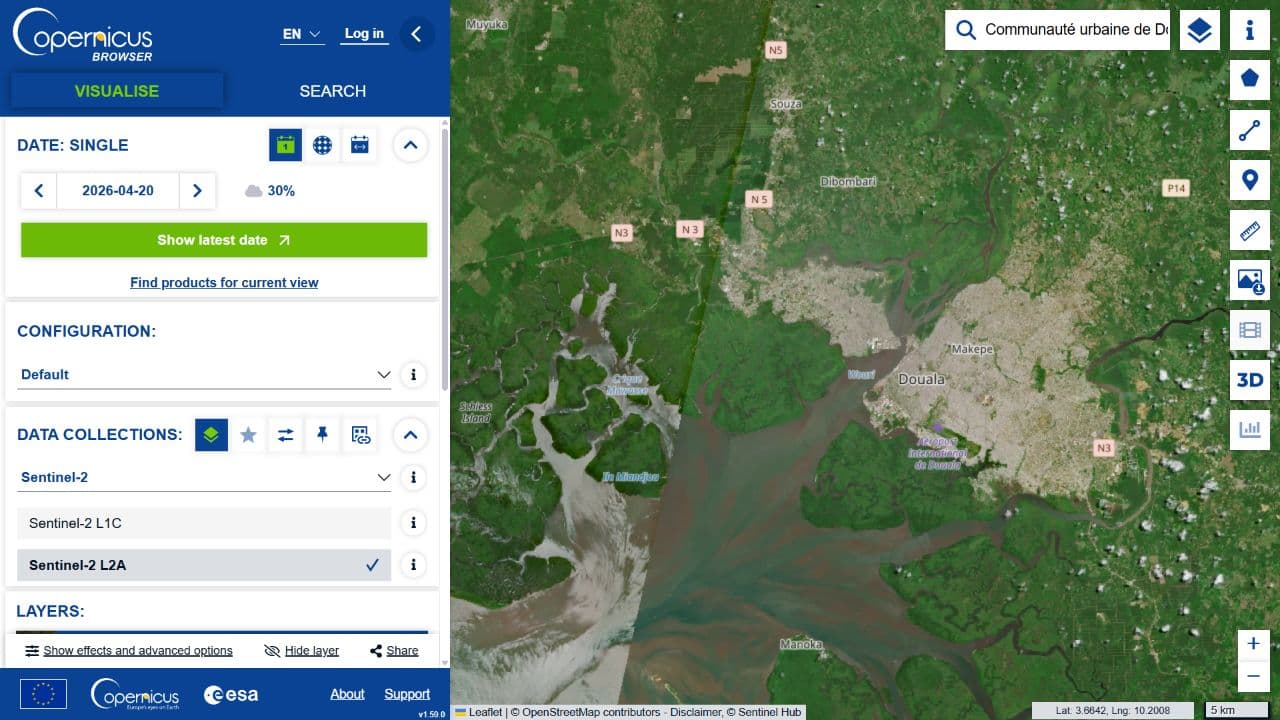
In the 2026 announcement, EVE relies on textual sources. ESA places the capability for searching and displaying satellite imagery in a later phase, scheduled for 2027. A response that specifies a Sentinel-2 scene should therefore not be described as an EVE visual analysis at that date. Even when such a tool becomes available, it will be necessary to know the processed product, its time stamp, and the processing steps.
For a class, a good exercise is to have AI compare its output to the official fact sheet for a tool. Students highlight the exact phrases, the overly vague phrases, and those that go beyond the data. They rewrite the answer, indicating the level of certainty. This work teaches scientific reading as well as the use of the tool.
Evaluate the system on multiple cases, not just a demonstration
A successful response in a public presentation does not tell us about the frequency of errors. To test a tool, we need to prepare a set of questions before starting the experiment and also keep track of failures. Distribute the cases among simple definitions, numbers to verify, local questions with few sources, and intentionally impossible requests. For each response, two people can independently record: source found, claim supported, correct date, correct unit, and recognition of limitations. In case of disagreement, they explain the disputed point rather than force a single score.
Translation adds a level of risk. A term like "ocean colour" may be rephrased without explaining that it refers to optical properties and derived products. A fluent French response may remove a validity condition present in an English document. Therefore, source passages should be checked in their original language and indicated when a paraphrase simplifies a topic. For a RECA article, citations should refer to the original organizations and publications, not just to the EVE output.
Protect data submitted to the wizard
A team may be tempted to copy internal reports, personal contact information, or non-public records into a public service. Before using them, the team must read the privacy policy and decide which information can be sent. Searching for a document response typically does not require sending a complete sensitive file. A general question can be asked, and the local data can then be processed in a suitable environment. Caution is required with both unpublished images and text.
Finally, the test protocol must be dated. EVE announces regular updates; an evaluation made in October 2026 may become obsolete after an update. Publishing the date, the version if available, and the questions used allows others to repeat the test. Transparency prevents a single criticism from becoming a permanent verdict, or a single success from becoming a promise of universal reliability.
A correction grid for the class or essay
Each answer can be evaluated on five simple criteria: the existence of sources, their relevance to the question, the accuracy of the numbers and units, the fidelity of the limits, and the transparency of uncertainty. Assigning a score to each answer provides a convenient summary, but written justification is still essential. An answer may cite a good source and draw an overly-strong conclusion; it should not receive the same evaluation as an answer that accurately describes what the document establishes. The score is meant to compare trials, not to definitively certify the tool.
To make the exercise reproducible, keep a copy of the question and the links that were open at the time of the test. A source site can be updated later. When two reviewers disagree, they look for the disputed passage in the original document. This discussion teaches better reading of evidence than a simple "AI is right" or "AI is wrong." It is also useful to ask the tool to rephrase after pointing out an error: does it clearly acknowledge the correction or produce a new, unverified claim?
Preserve a place for local expertise
A corpus rich in international documents may lack Cameroonian studies, field measurements, or Francophone publications. A general response on mangroves is not sufficient to describe the state of a specific Wouri site. The local expert knows the methods used, the seasons, and the gaps in the data. The assistant can save the expert time in locating instrumental documentation; he should not be presented as an arbiter when a local observation contradicts a general summary.
This distinction is also a matter of scientific fairness. If tools always cite the same institutions, regional work may remain invisible. Evaluating EVE on African issues should therefore include the diversity and relevance of sources, not just the grammatical correctness of the answer.
What this changes – or does not change – for Central Africa
An assistant can help a small team quickly find the spatial documentation needed to answer a local question. It does not compensate for the absence of a valid scene, field measurements, or an appropriate geographic analysis. A RECA testbed could compare twenty French-language questions about rainfall, coastlines, and crops in Central Africa: the number of valid links, unit errors, unjustified answers, and the ability to say "insufficient information." Publishing the failures would also make this test credible. AI then becomes an object of evaluation, not an anonymous authority placed above the sources.