
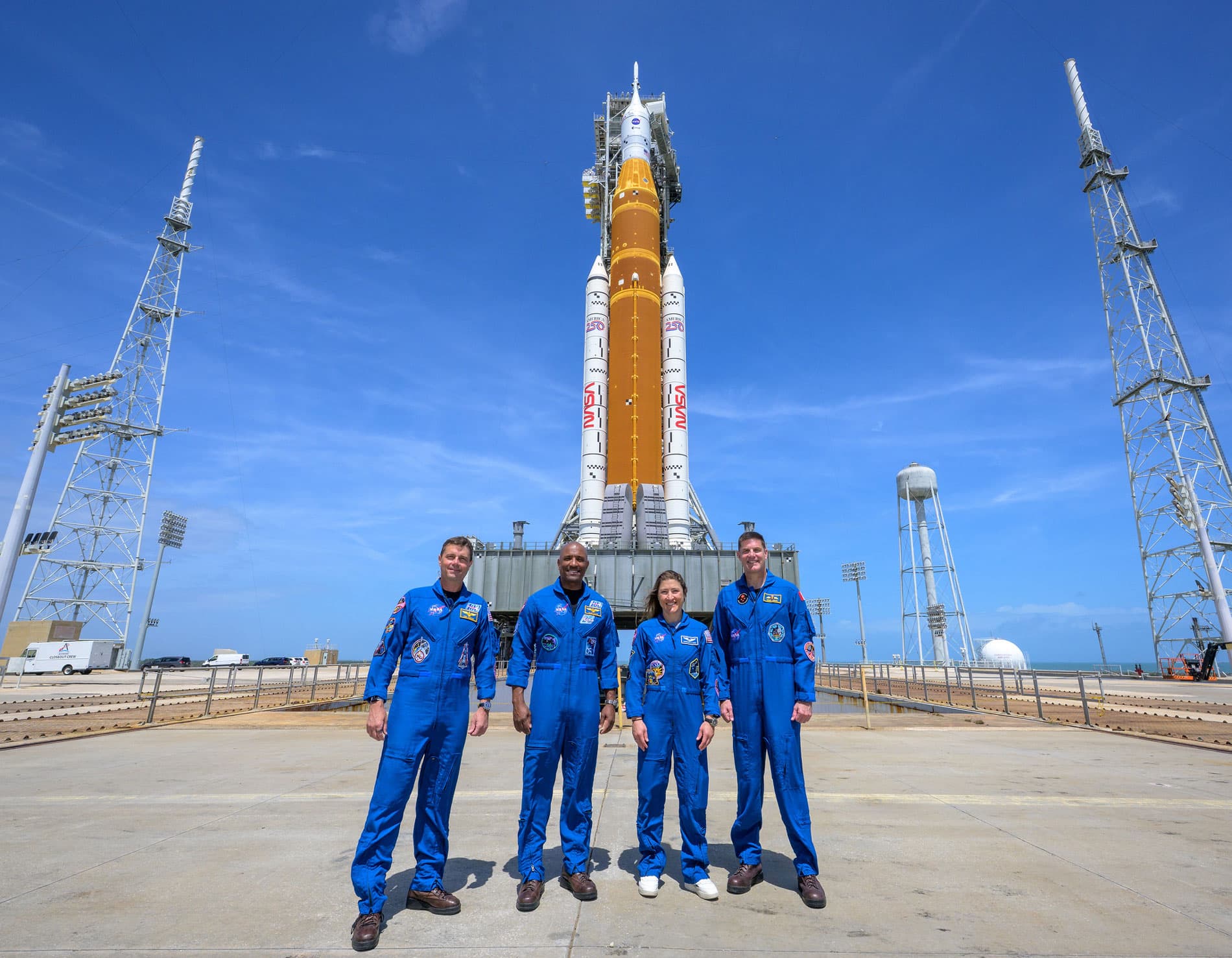
In 2026, RECA Space Agency, in collaboration with the University of Douala, was selected by NASA among 34 international participants invited to contribute to the radio monitoring of the Artemis II mission.
This selection has placed a Cameroonian organization within an international network of space agencies, universities, specialized companies and radio organizations from several countries.
A Mission Around the Moon
Artemis II is the first manned mission of the Artemis program to make a trip around the Moon.
The mission took off on April 1, 2026 aboard the Space Launch System (SLS) launcher, with the Orion spacecraft and four astronauts on board. Orion made its journey into deep space before returning to Earth on April 10, after about ten days on the mission.
To support this mission, NASA has mobilized its core communications and navigation infrastructure, including the Near Space Network and the Deep Space Network.
In parallel, NASA has opened an initiative allowing external actors to participate in the passive monitoring of radio signals emitted by Orion.
The role of the international network
NASA has selected 34 participants from around the world. Together, their infrastructures represented some 47 ground facilities in 14 countries.
The principle was to allow participants to use their own equipment to listen to and record the radio signals transmitted by Orion during its journey around the Moon.
This was passive monitoring: the participants did not control Orion and did not replace NASA's official communication networks.
The data collected could contribute to the analysis of the behaviour of radio signals and the evaluation of monitoring capacities from external infrastructures.
RECA Space Agency and the University of Douala
In the official list published by NASA, the Cameroonian participation appears under the designation:
Reca Space Agency and the University of Douala, Cameroon
This participation is an important step in the development of RECA's capabilities in the field of space communications and the ground segment.
In particular, it makes it possible to work on concrete problems related to radio reception, the monitoring of a space target, the analysis of signals and the management of data from a monitoring campaign.
For RECA, the interest of this mission therefore goes beyond simply listening to a spacecraft.
It represents an opportunity to compare the skills developed locally with a real space mission and an international technical framework.
An experiment focused on deep space
Tracking Orion has different constraints than tracking low-orbit satellites.
As a spacecraft moves away from Earth, receiving signals becomes more demanding. The distance, the received power level, the Doppler, the geometry between the station and the vehicle as well as the characteristics of the antenna and the reception chain become essential parameters.
This experience contributes to RECA's objective of progressively developing expertise in communications and monitoring of deep space missions.
A step for Cameroonian space capabilities
Participation in Artemis II is part of a broader approach to skills development around ground stations, space communications and mission data processing.
It is also a concrete demonstration of what an African organisation can achieve by integrating into international space research and exploration initiatives.
So for RECA Space Agency, Artemis II is not just a mission that we've been on.
It is a technical experience that helps build the skills needed for future African space infrastructure.
Sources and references
NASA — “NASA Selects Participants to Track Artemis II Mission,” January 23, 2026. NASA confirms the selection of 34 international participants and explicitly mentions "Reca Space Agency + University of Douala, Cameroon" in the official list.
Read the official NASA article
This is NASA's Artemis II mission. Official information on the mission, its crew, its progress and its objectives.
Check out NASA's official Artemis II page
RECA Space Agency — Missions. Presentation of RECA's participation in the radio monitoring of Artemis II and the agency's other programmes.