

For a long time, designing and launching a satellite into space was the preserve of large space agencies, governments, and corporations with considerable resources.
Today, this reality is evolving.
The advent of CubeSats has profoundly changed the way universities, labs, startups, and new space organizations can design orbital missions.
A satellite that fits within a few centimeters
A CubeSat is a satellite built according to a standardized architecture based on units called "U".
A CubeSat 1U is about 10 × 10 × 10 cm. Multiple units can be assembled to form larger platforms: 2U, 3U, 6U, 12U and more.
This standardization makes it possible to reduce some of the complexity associated with the design of a satellite.
Rather than designing each element entirely from scratch, teams can rely on components, mechanical interfaces, electronic systems and launch infrastructures adapted to this format.
The result is important: a space mission can be designed with much more limited resources than before.
Reduce cost without removing complexity
A CubeSat is small, but a CubeSats mission is still a real space mission.
Power supply, thermal control, communications, on-board computer, data storage, attitude determination and control, embedded software and payload must be managed.
However, miniaturisation makes it possible to use much more compact and energy-efficient electronic components.
Teams can also separately develop and test the different subsystems before they are integrated into the satellite.
This approach makes projects more accessible to universities and small structures, while allowing students and young engineers to participate directly in the design of a complete space system.
Laboratories in orbit
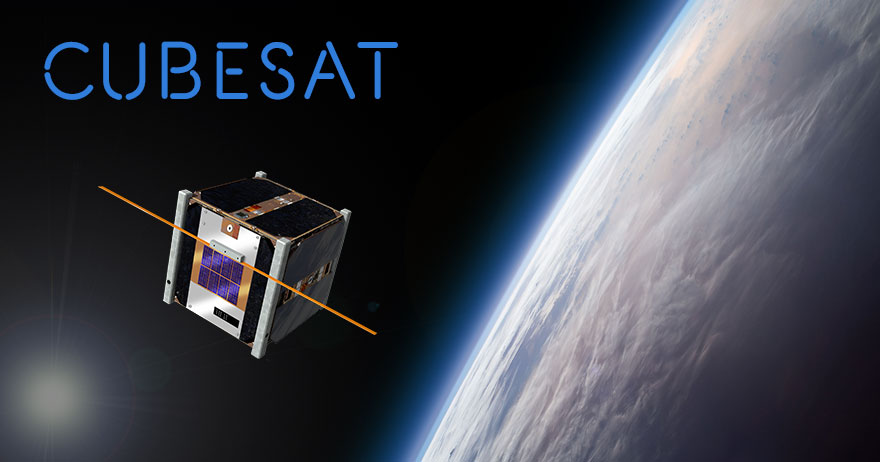
One of the main interests of CubeSats is their ability to serve as experimental platforms.
A small satellite can embark a camera, a scientific sensor, a technology demonstrator, a communication system or an experiment intended to test a new technology in space conditions.
The orbit then becomes a real laboratory.
A technology can be developed on Earth, miniaturized, integrated into a CubeSat and then tested directly in the space environment.
This possibility greatly accelerates the experimentation with new technologies.
A new gateway for universities
CubeSats have also transformed training in the space sector.
The construction of a satellite requires the combination of several disciplines: electronics, mechanics, computer science, telecommunications, automation, signal processing, artificial intelligence, data science and physics.
A CubeSat project therefore becomes a particularly complete learning environment.
Students are no longer just working on simulations or lab prototypes. They can participate in a project whose final system is intended to actually function in orbit.
It is also a means of developing skills locally which can then be reused in other technology sectors.
The essential role of ground stations
Putting a CubeSat into orbit is only half the problem.
Once you're in space, you have to be able to communicate with him.
The satellite must receive commands from Earth and transmit its data to one or more ground stations. This requires antennas, radio systems, control software and procedures to plan and execute communication sessions.
This is where space communications take on their full importance.
A CubeSat without a suitable communication and monitoring infrastructure quickly becomes a difficult platform to operate.
The development of networks of ground stations therefore makes it possible to multiply the possibilities offered by these small satellites.
An opportunity for Africa
For African countries wishing to develop their space capabilities, CubeSats represent a particularly interesting avenue.
They make it possible to start building national expertise around concrete missions without having to immediately have the necessary infrastructure for the design of large conventional satellites.
But the goal shouldn't be just to “build a small satellite.”
The challenge is to gradually master the whole chain: mission definition, design of subsystems, integration, testing, launch, communications, ground control, data processing and scientific exploitation.
It is this gradual mastery of the value chain that makes it possible to transform an academic project into a real space capability.
For the RECA space agency
For RECA Space Agency, CubeSats thus represent a particularly interesting technology in the construction of an African space ecosystem.
They bring students, engineers, researchers and developers closer to the real problems of the space industry: on-board systems design, communications, software, data processing and mission operations.
So CubeSats are not making space simple.
They simply make its access more open.
And in an industry where each new capability often begins with a first mission, this evolution could play a major role in the emergence of new space powers, including on the African continent.