
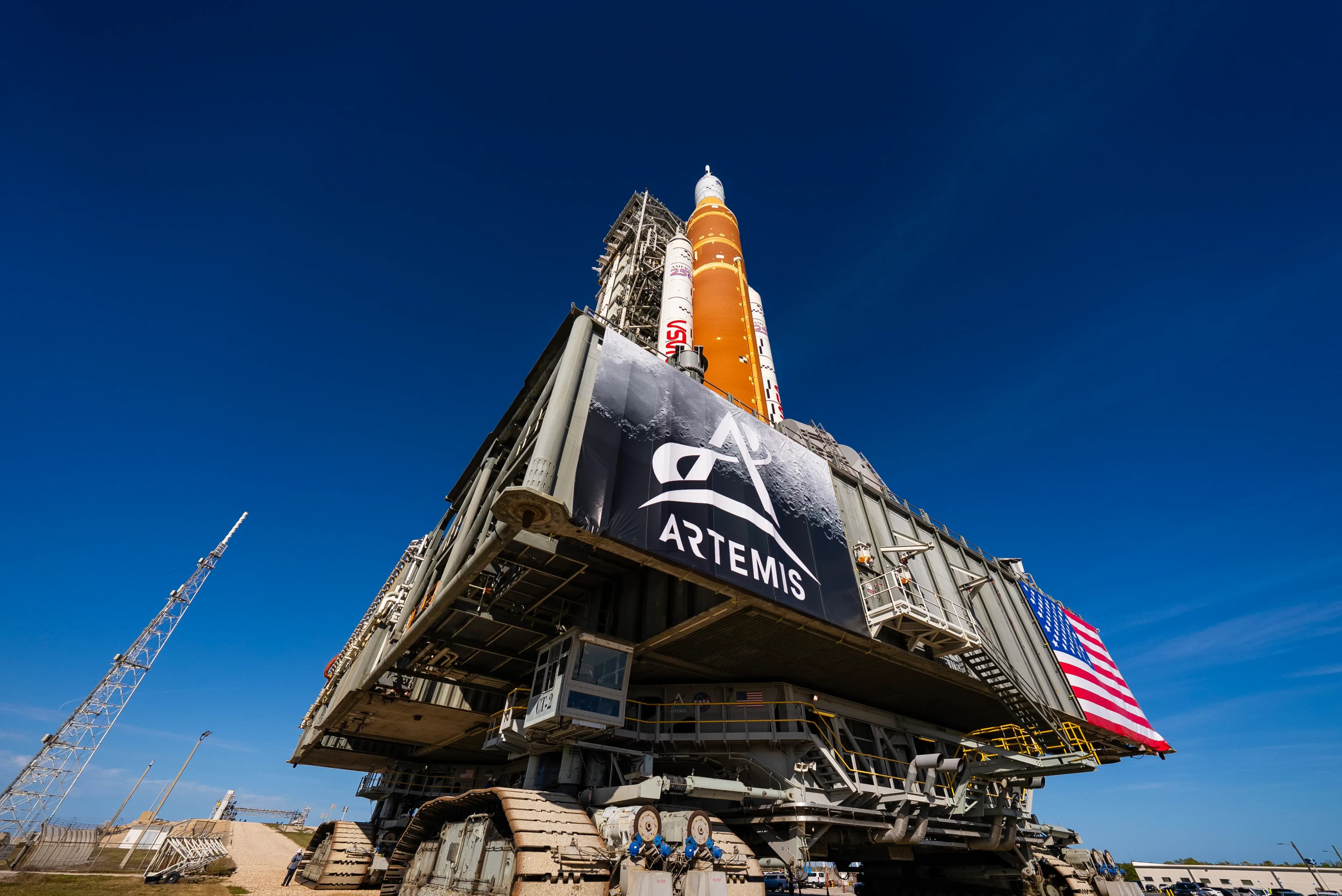
On January 23, 2026, NASA announced the selection of 34 participants from around the world to contribute to the follow-up of the Artemis II mission, the first manned mission in the Artemis program to send astronauts around the Moon.
Among the organizations selected was a name from Cameroon: RECA Space Agency, in collaboration with the University of Douala.
For RECA, this selection represents much more than institutional recognition. It is a new illustration of the capacity of African actors to take part, at their level, in major international space exploration initiatives.
A Historic Mission to the Moon
On April 1, 2026, the Space Launch System (SLS) rocket took off from the Kennedy Space Center in Florida, carrying the Orion spacecraft and four astronauts: Reid Wiseman, Victor Glover, Christina Koch and Jeremy Hansen of the Canadian Space Agency.
Artemis II had a major ambition: to test, with a human crew, the capabilities of the SLS-Orion system in the environment of deep space and to make a trip around the Moon before returning to Earth.
After more than fifty years since the last manned lunar missions of the Apollo era, four human beings would once again travel to the lunar region.
On April 6, the crew of Artemis II even surpassed the previous record for distance traveled by humans from Earth, set during the Apollo 13 mission in 1970.
The mission ended on April 10, 2026 with Orion returning to Earth after nearly ten days of travel.
34 participants, one common goal: follow Orion
But a space mission doesn't just rely on astronauts and crews at the control centers.
For Artemis II, NASA has mobilized an international network of ground assets to help track the Orion spacecraft during its journey around the Moon.
The US agency selected 34 international participants from governments, universities, companies and organisations specialising in communications and monitoring of space missions. In total, about 47 ground facilities in 14 countries were involved in the monitoring system.
It is in this context that RECA Space Agency + University of Douala, Cameroon appears in the official list published by NASA.
A Cameroonian participation in a lunar mission
As part of this initiative, RECA Space Agency representative Louis Paul Mandack was selected as one of 34 international participants selected by NASA to contribute to the follow-up of Orion during Artemis II.
The goal was not to join the crew of Artemis II, nor to join NASA's operational teams, but to participate, from Earth, in the international ecosystem set up to follow the ship during its journey into deep space.
This distinction is important.
It illustrates an often overlooked reality: modern space exploration relies on a vast international network of skills, infrastructures and enthusiasts capable of contributing to missions far beyond the borders of major space agencies.
And this time, Cameroon was one of them.
From Douala to deep space
For RECA Space Agency, this participation is part of a broader ambition: to contribute to the development of a Cameroonian space ecosystem capable of dialogue with institutions, universities, companies and international organizations in the sector.
The presence of RECA and the University of Douala in the official list of participants in Artemis II is thus an important signal for Cameroonian students, engineers, researchers and enthusiasts.
It recalls that access to the space sector is not limited to building rockets or sending astronauts.
Space communications, mission tracking, data analysis, software, networks, artificial intelligence, Earth observation and scientific research are also areas in which African talent can contribute.
Looking at the moon, but most importantly preparing for the next one.
Artemis II was just a step.
The purpose of the mission was to prepare the future stages of the Artemis program and to build the capabilities needed for future manned missions to the Moon. NASA also presents Artemis as a stepping stone to more distant human missions, including to Mars.
For the RECA Space Agency, the stakes are therefore greater than just one mission.
The aim is to gradually build a credible Cameroonian presence in the space field, to create opportunities for young talents and to demonstrate that Africa can participate in the great scientific and technological adventures of its time.
Artemis II took four astronauts around the Moon.
From Cameroon, RECA was one of the actors selected to follow their journey.
And for us, that's not a conclusion.
It is the beginning of a road.