
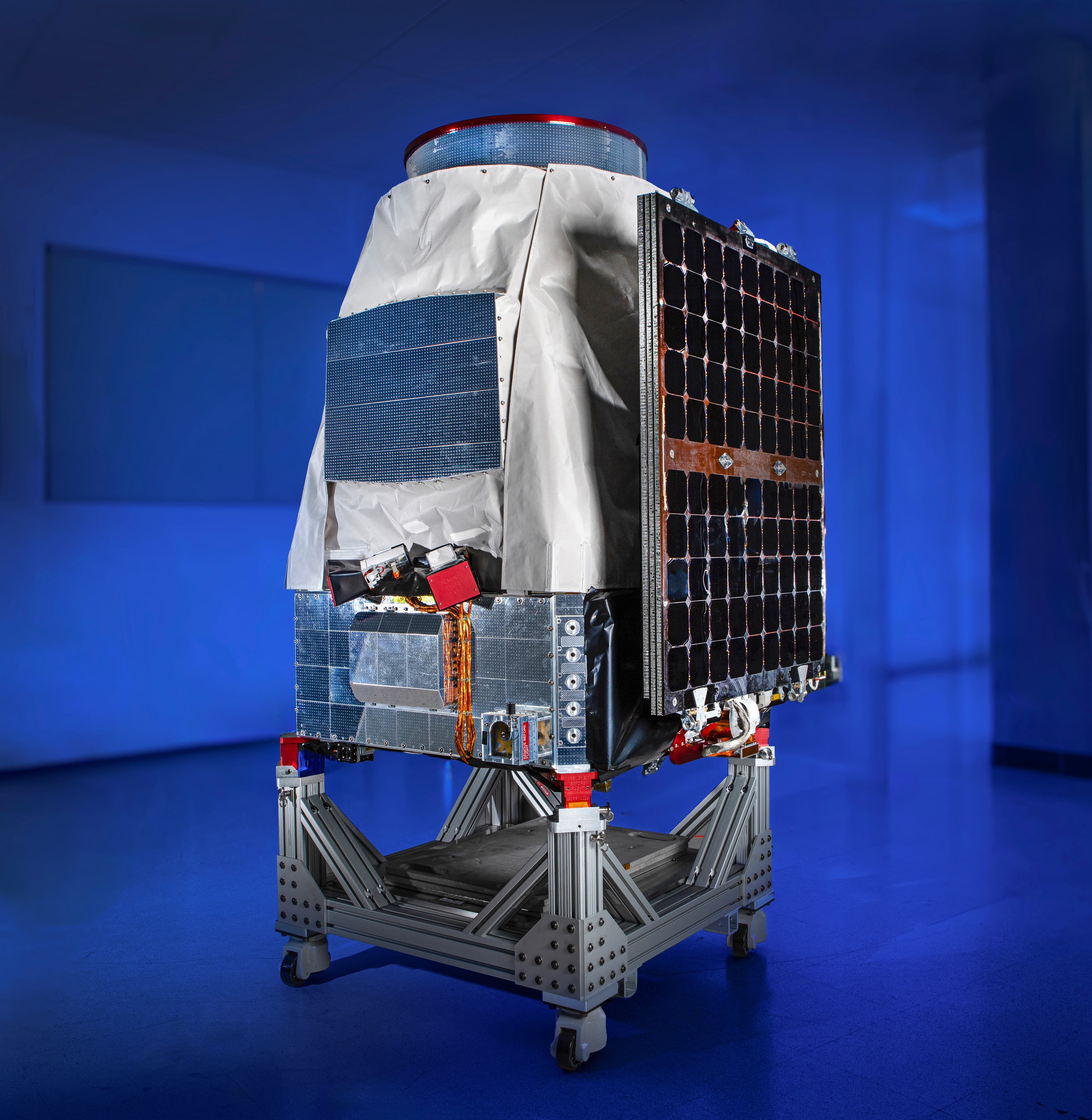
On August 25, 2026, NASA announced the start of scientific observations by Pandora, a small space telescope dedicated to exoplanets and their stars. Its goal is not to count the greatest number of new worlds. It addresses a more subtle challenge: when we believe we are reading the composition of a planet's atmosphere in the light of a star, some of the signal may come from the star itself. Ignoring this contamination can turn a fragile measurement into a spectacular assertion. Pandora is therefore seeking to improve the quality of interpretation, particularly for observations made with the James Webb Space Telescope.
Observe a transit without confusing the sources of light
Some exoplanets pass in front of their star as seen from Earth. During this transit, they obscure a very small fraction of the star's surface. Some of the light passes through the upper atmosphere before reaching the telescope. Molecules absorb some wavelengths more than others, so the measured spectrum can provide clues about gases, clouds, or haze. This is a powerful method, but it does not magically isolate the planet from the rest of the star.
A star is not a perfectly uniform disk. It has cooler and darker regions, comparable to spots, as well as hotter and brighter regions. Their visibility changes with the rotation and stellar activity. If the planet blocks a particular region during a transit, the measured contrast changes. Even parts of the star not traversed by the planet influence the total signal. A signature resembling that of water vapor can then be amplified, attenuated, or mimicked by the stellar surface. The right question is not just "what do we see?" ", but "which part of the signal belongs to what?".
Why is Pandora looking at two fields of light?
Pandora simultaneously measures the brightness in the visible and spectra in the near-infrared. These measurements respond differently to hot and cold regions of the star. By combining the data, the researchers hope to better characterize the stellar surface at the time of transit and separate its effects from the signatures of the planetary atmosphere. The observatory carries a telescope with a diameter of about 45 centimeters; its near-infrared detector comes from a spare component developed for Webb. This detail illustrates an engineering approach: reusing known hardware for a more targeted mission.
The strategy also relies on observation time. According to NASA, Pandora must observe at least twenty exoplanets during its one-year primary mission, about ten times each, with sequences lasting up to twenty-four hours. Observing before, during, and after the transit allows for establishing the star's baseline and seeing how it evolves. A single measurement may be tempting; ten visits allow for testing repeatability. If a signature varies greatly from one transit to the next while the planet is unlikely to change that quickly, stellar activity becomes an explanation to consider.
What the August launch confirms — and does not confirm
Pandora was launched on January 11, 2026, and its teams carried out a commissioning phase. The announcement of August 25 indicates that the spacecraft and its instruments were deemed capable of starting the scientific program. It does not present the discovery of a habitable atmosphere, much less the detection of life. The mission's objectives include the study of clouds, fogs, and molecular signatures in atmospheres that are already accessible to observation. The results will have to be produced, analyzed, and compared with those of other instruments.
This caution also applies to the word "water." Detecting a signature consistent with water vapor in a spectrum does not mean that a liquid ocean has been seen. We need to know whether the signal really comes from the planet, what type of planet is being observed, what its temperature is, and what other molecules are present. Many of the targets of Pandora are planets far from Earth-like conditions. The search for habitability is a long-term goal that requires multiple lines of evidence, not just a single absorption in a graph.
A complementary mission for Webb, not a miniature Webb
Webb has a sensitivity and instruments that are incomparably more powerful for many phenomena. But its time is required by thousands of programs, and it cannot devote endless sequences of repeated observations to each star. Pandora brings a form of specialization: simultaneous and repeated observations, chosen to understand stellar contamination. The two missions can therefore produce a better interpretation together than either one can alone. A beautiful Webb spectrum gains credibility when a second independent series provides information about the star’s behavior.
NASA specifies that the scientific data from Pandora are accessible through the Exoplanet Archive. Open access does not make analysis trivial: it is necessary to distinguish between raw data and calibrated products, read uncertainties, choose a statistical method, and document the parameters. However, it provides a learning ground for teams that do not have a space telescope. A student project can begin by reproducing a transit curve or comparing multiple visits to the same target, without claiming to immediately discover a new planet.
An exercise possible from Cameroon
The connection with Central Africa is not geographical: Pandora does not observe a terrestrial region. It is educational and scientific. A team of physicists, computer scientists, or mathematicians can build a simple model of a star with a dark spot, send a virtual planet through it, and measure the apparent depth of the transit depending on the position of the spot. They can then compare two color bands and test whether the difference comes from the stellar model or from an added atmosphere. This project involves programming, optics, statistics, and critical thinking.
The most important part of the report would be the list of assumptions. Does the simulated star have a single spot or multiple spots? Does the planet always follow the same trajectory? Do the measurements include noise? What amplitude of difference would be detectable with a real instrument? These questions prevent a naive reading of the graphs and teach a general principle of data science: a spectral correlation is not enough to identify its cause.
Open data is not enough without its context
NASA specifies that the scientific data from Pandora will be available in the US Exoplanet Archive. This availability opens up opportunities for teams far from the major observatories, but downloading a curve does not mean understanding it. It is necessary to know the versions of the processing, the periods when the instrument was being calibrated, the rejected measurements, and how the star's activity was modelled. A small anomaly in a time series may be a real phenomenon, an instrumental variation, or a quality problem. The data file and the methodological articles are therefore as important as the final graph.
A university project can compare the interpretation of a transit with and without information about the star. Students must define in advance what they consider to be an improvement: a decrease in uncertainty about a parameter, consistency between successive passages, or better agreement with independent measurements. They must also identify systems for which the correction does not help. This is exactly the logic of the mission: to measure the stellar context in order to avoid attributing too quickly to a planet what comes from its sun.
Future press releases will have to specify which planets were actually observed and how many passages were selected after quality control. The list planned at the beginning of a mission may change; only a validated series allows the result to be evaluated.
Pandora is embarking on a mission of patience. By returning to the same systems repeatedly, it must better separate the activity of the stars from the signatures of their planets. If it succeeds, announcements about distant atmospheres will be based on more robust interpretations — a less spectacular advance than a supposed "new Earth," but much more useful for research.