
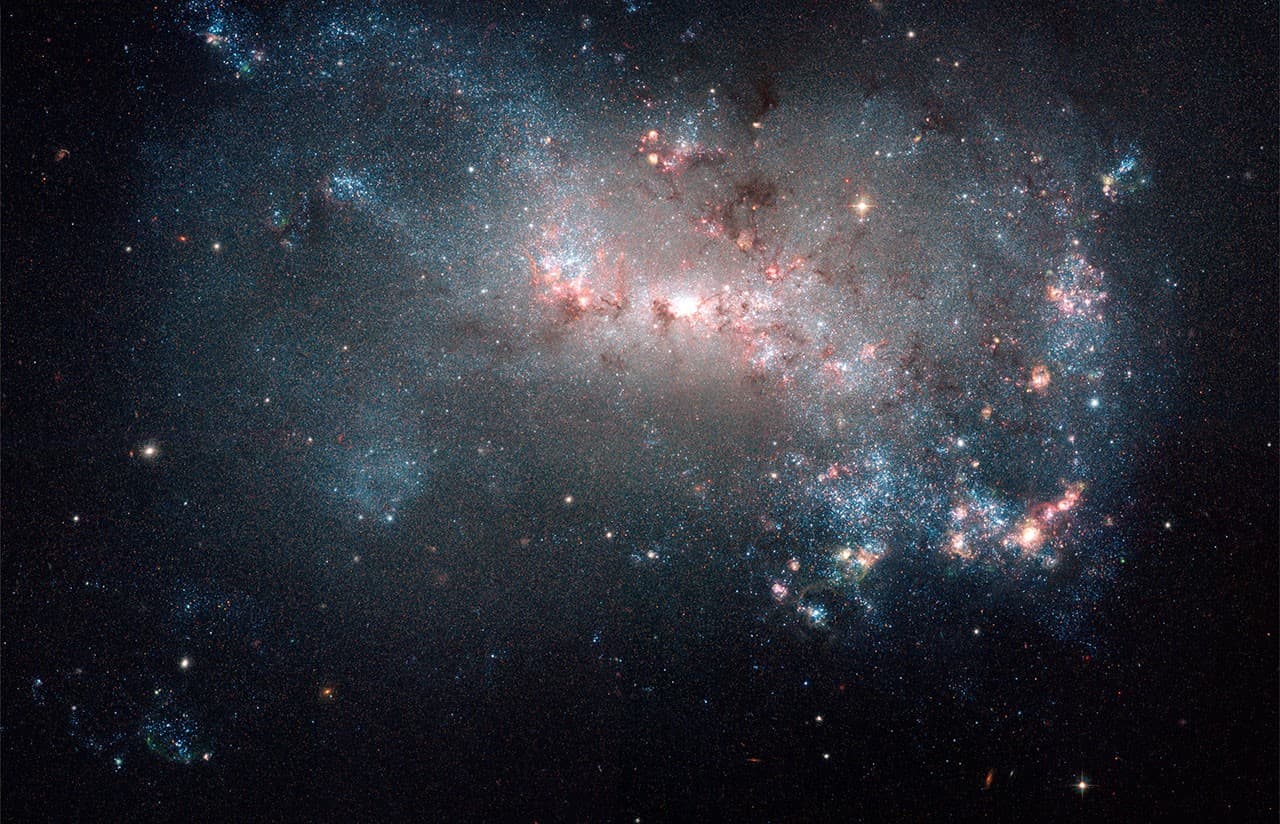
On November 2, 2026, NASA presented a study of 37 nearby dwarf galaxies. By reconstructing their history of star formation and comparing the expected amount of oxygen with that found today, the researchers concluded that a large portion of this element is missing within the galaxies themselves. The word "missing" requires an explanation: oxygen has not disappeared from the Universe. Stars made it, and then energetic processes probably ejected a significant fraction of the enriched gas from these small galaxies. The study now poses a measurable question: where did this matter end up?
Why Oxygen Tells the Story of the Stars
After hydrogen and helium, oxygen is one of the most abundant elements in the cosmos. It is produced by generations of stars and released, among other ways, when massive stars die. Its signature in the light of the gas can be measured; its abundance therefore serves as a tracer of chemical enrichment. Researchers do not count atoms one by one on a Hubble image. They combine observations of stellar populations, models of star evolution, and gas measurements to estimate the amount produced and still present.
It should not be confused with the breathable oxygen of a planetary atmosphere. The study focuses on the chemical composition of clusters of gas and stars at the scale of entire galaxies. It does not point to a habitable planet, and the abundance of oxygen in a galaxy does not say anything directly about the existence of life. The choice of this element is mainly methodological: its production is relatively well understood and its spectral lines are useful for tracking matter.
How to rebuild a balance sheet without looking at the past
The GLOW project, for Galaxies Losing Oxygen via Winds, selected 37 dwarf galaxies that are close enough for Hubble to distinguish some of their individual stars. The color and brightness of these stars help reconstruct the periods during which the galaxy formed many or few stars. With assumptions about stellar masses and element production, the team estimates how much oxygen these generations must have produced. They compare this estimate to the amounts detected in the stars, gas, and dust.
This calculation is a balance sheet with uncertainties. The faintest stars are not all observed in the same way, chemical production models have error margins, and the gas around the galaxy is difficult to inventory. That's why researchers are studying a set of galaxies rather than a single remarkable object. If a trend emerges in 37 different mass and environment systems, it becomes harder to explain as the result of a single image's inherent error. The Hubble archive data were supplemented by observations from other observatories, including Spitzer and ground-based radio networks.
Galactic winds as the main clue
A dwarf galaxy has less gravity than a large galaxy. Supernova explosions and the activity of massive stars can move gas and push some of it out of the region where the stars are located. This galactic wind also carries the elements produced by the stars. The study suggests that this loss of oxygen is more efficient in the observed systems than some current models predict. This does not mean that every dwarf galaxy is devoid of all its heavy elements; it indicates that the current inventory is lower than expected production.
Where does the expelled gas go? It could remain in a diffuse halo around the galaxy, the circumgalactic medium, or be carried further into the space between galaxies. NASA points out that this distribution is not yet clear for the majority of the missing oxygen. The next step in the work will be to look for signatures of this tenuous gas and compare galaxies that are even less massive. A new observation that locates some of the oxygen would modify the balance without cancelling the initial result: it would clarify the path of the matter.
What the photo of NGC 4449 shows
The Hubble image used here shows NGC 4449, one of the galaxies in the sample. Its bright regions and blue stars indicate active star formation. The image is not a map of missing oxygen. The deficit results from a comparison between several types of measurements and production models. It is essential to state this in the caption, because a very beautiful image can give the impression that the entire scientific conclusion is directly visible. A photograph documents an object; an analysis explains what can be deduced from it.
The team plans to continue the investigation with the Roman space telescope, whose wide coverage of the sky will allow the detection of fainter dwarf systems. Hubble and Webb will then be able to study some of these objects in detail. Research is thus progressing through a division of labor among the instruments: identifying, selecting, observing in depth, and comparing the results with models. The November announcement concerns the current study of 37 galaxies, not the discovery already made by Roman of the oxygen's origin.
A good question to teach the scientific method
The problem can be framed as a balance sheet exercise: estimated production minus recovered material equals the quantity to be located, with uncertainty on each term. This is an excellent entry point for African students in astronomy, statistics, or data science. They can explore a public image of NGC 4449, then read the scientific article to identify which measurements are not present in that image. The goal is to learn to distinguish observation, model, and interpretation, rather than simply repeating that "Hubble saw oxygen disappear."
The result also shows that small galaxies are not simply scaled-down versions of the Milky Way. Their low gravity can transform their chemical evolution. Understanding this process helps explain how galaxies enrich the gas around them and how generations of stars form from matter that has already been modified by previous generations.
The problem of invisible matter in the balance sheet
Saying that there is a "shortfall" in oxygen does not mean that the instrument has seen atoms disappear. Researchers compare an estimated production to the amount they can find in the observable components of each galaxy. There may be low, dispersed, or difficult-to-measure gas around it. Dust can also complicate the interpretation of certain observations. Each hypothesis changes the balance, and each measurement has an error margin. That is why the study of 37 galaxies provides a trend to examine rather than a perfect inventory of every atom produced since their birth.
Galactic winds provide a plausible mechanism. When massive stars inject energy into their surroundings, the enriched gas can escape from the regions where stars are born. In a small galaxy, the weaker gravity facilitates this movement. But a single image does not measure either the total mass carried away or its final destination. It is necessary to combine spectroscopy, stellar formation models, and gas observations to test this explanation. The scientific work consists precisely in verifying whether the calculated losses can explain the chemical discrepancy, and in identifying the parameters that remain poorly constrained.
Why is this question beyond the neighboring galaxies?
The first galaxies in the Universe were often small. Understanding how low-mass systems retain or expel the elements produced by their stars helps reconstruct the chemical enrichment of the cosmos. However, one cannot apply without caution a measurement made on nearby galaxies to all epochs: the environments, masses, and intensity of star formation differ. Hubble's result provides a piece of the puzzle and a method of comparison. Future work may compare it to other samples and different wavelengths, explaining the uncertainties rather than announcing a mysterious disappearance of oxygen.