
On November 2, 2026, NASA announced a crucial milestone for ESCAPADE, its two-satellite mission to study the environment of Mars. The spacecraft are due to return near Earth, one on November 7 and the other on November 9, and then fire their engines as they pass. Earth's gravity will deflect their trajectory; the extra thrust will put them on course for Mars. As of November 5, these maneuvers are still scheduled: their success should not be taken for granted. The significance of this announcement goes beyond the schedule of a mission. It shows how a team can use time, orbital mechanics, and a firing window to reach a distant destination.
Why do two probes have to return to Earth?
ESCAPADE was launched in November 2025, when the geometry between Earth and Mars did not favor a direct departure. Instead of immediately following the usual interplanetary trajectory, the two spacecraft traveled a large loop around the L2 Lagrange point of the Earth-Sun system. They are now returning to our planet at a time when the relative positions of the two planets allow for departure. This trajectory may seem paradoxical on a map: one first moves away from the apparent destination in order to then have a possible trajectory and a useful speed.
A Lagrange point is not a stationary parking lot. The gravity of the Sun and that of the Earth create a dynamic configuration there allowing certain orbits, but spacecraft remain in motion and their navigation must be corrected. In the case of ESCAPADE, the phase near Earth also served to test the systems and to collect measurements of Earth's magnetosphere. NASA indicates that the probes crossed a distant part of the magnetic tail, stretched opposite the Sun by the solar wind. These preliminary data are not yet a detailed result on Mars; they are additional science during the journey.
Gravitational assistance and engine ignition
Gravitational assistance allows a spacecraft to change its direction and speed relative to the Sun by passing near a planet. The planet does not provide free fuel in the literal sense: the exchange of energy and momentum is explained by orbital mechanics. The variation in the Earth's orbit is infinitesimal, while the effect can be decisive for a small spacecraft. The angle of approach and the time of passage determine the trajectory obtained. A delay or a navigational error is not always corrected by a simple final correction.
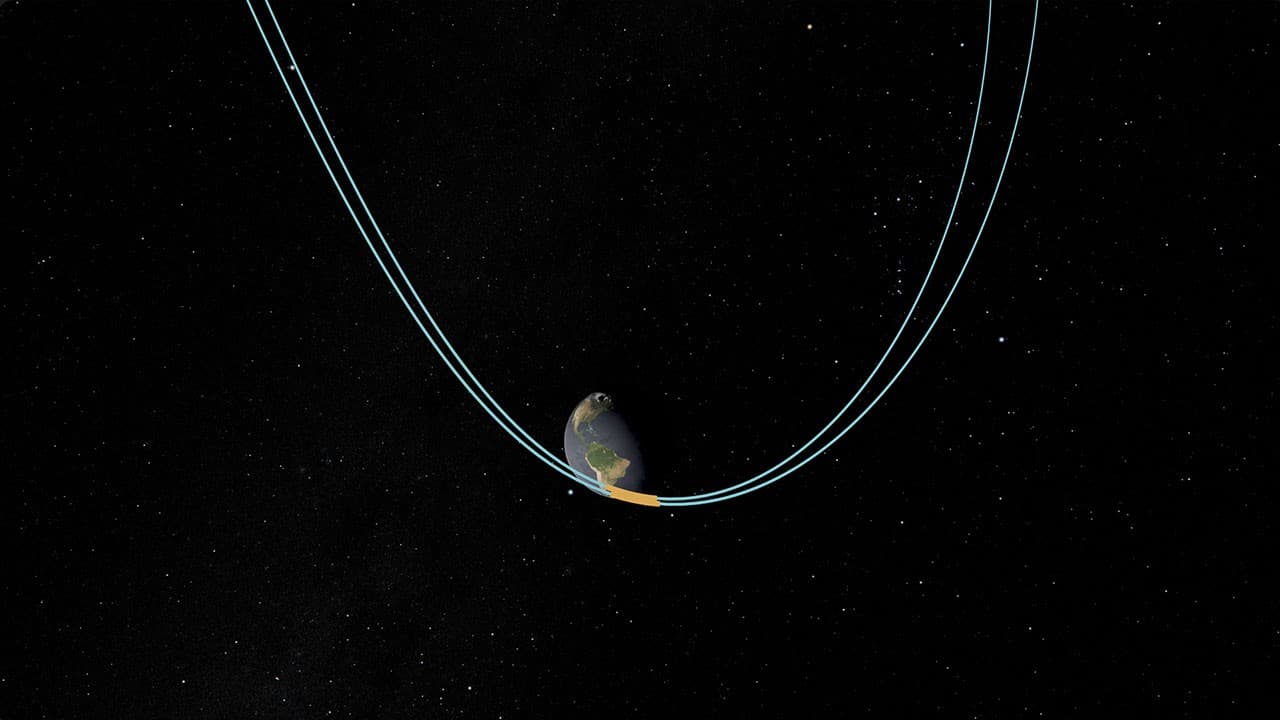
ESCAPADE adds an engine burn near the Earth crossing. According to NASA, each injection burn to Mars should last about nine minutes. The first crossing is scheduled for around 5 p.m. Eastern Time on November 7; the second is about two days later. The engine adds speed to a point where the spacecraft is already moving quickly. This is the point of the Oberth maneuver: the same amount of propulsive energy can have a significant effect on the final orbit when applied at the right time. An animation shows the planned geometry, but the final figures will depend on measurements after the passes.
Why separate the two departures?
The probes are designed to work together on Mars, but they do not necessarily have to take exactly the same path at any given moment. The two-day delay allows each to execute its own maneuver in a consistent manner. NASA is planning an arrival in September 2027, two days apart. After this arrival, several corrections and orbit changes will still be necessary before coordinated scientific observations can begin. Speaking now of "two probes orbiting Mars" would confuse a future goal with a step that is only planned.
In the days following the flybys, the teams will analyze the telemetry, the actual duration of the firings, and the reconstructed trajectory. If the direction obtained does not exactly match the target, corrective maneuvers are still possible during the cruise. This check is more informative than a binary "success" or "failure" immediately after the flyby. It will also be necessary to verify that both vehicles remain in good condition, that their communications are reliable, and that the fuel margin is sufficient for operations on Mars.
The scientific objective: to understand the Martian atmosphere
Official video, broadcast without modification. Credit: undefined.
Solar wind is a stream of charged particles emitted by the Sun. It interacts with the magnetic and atmospheric environments of the planets. Mars today has an atmosphere that is much thinner than Earth's. Researchers want to better understand how solar energy and particles contribute to the escape of this atmosphere over time. A spacecraft measures a local state at a given moment; two coordinated vehicles can help distinguish a variation in space from a variation over time.
ESCAPADE instruments will measure particles, magnetic fields, and plasma, among other things. The mission alone will not reconstruct the entire Martian climate history. Its data will be compared to previous observations, physical models, and measurements from other missions. This caution is important: an announcement of launch or a beautiful animation may give the impression that the scientific answer is already known, when the main work has not even begun.
What this trajectory teaches future engineers
The launch illustrates several concrete skills: orbit calculations, prediction of uncertainties, remote control, engine control, ground stations, and telemetry processing. A small African team studying a space mission can reproduce certain steps on a computer, without having a launcher: calculating a simplified trajectory, changing the time of the launch, comparing arrival times, and explaining the assumptions of the model. The exercise quickly reveals why a "travel date" is not enough to describe a mission.
On November 5, history is being told to the future. The dates to watch for on November 7 and 9 will be those at which each vehicle's maneuver is confirmed. Then, the NASA announcement will be compared to the measurements published afterwards. The stakes are not just to reach Mars, but to do so in conditions that will enable the scientific observations promised.
How to verify a flyover ad
The confirmation will not be contained in a single photograph. After each pass, teams will be able to compare radio contact schedules, the reconstructed trajectory, and engine telemetry with the expected values. A successful flyby must place the probe on a route compatible with the rest of the journey; a firing engine is not by itself proof that the final speed is correct. Subsequent corrections are part of normal space navigation, but their magnitude will indicate the precision of the maneuver. So we will distinguish the initial announcement, the follow-up data, and any corrections before we can speak of a definitively confirmed departure.
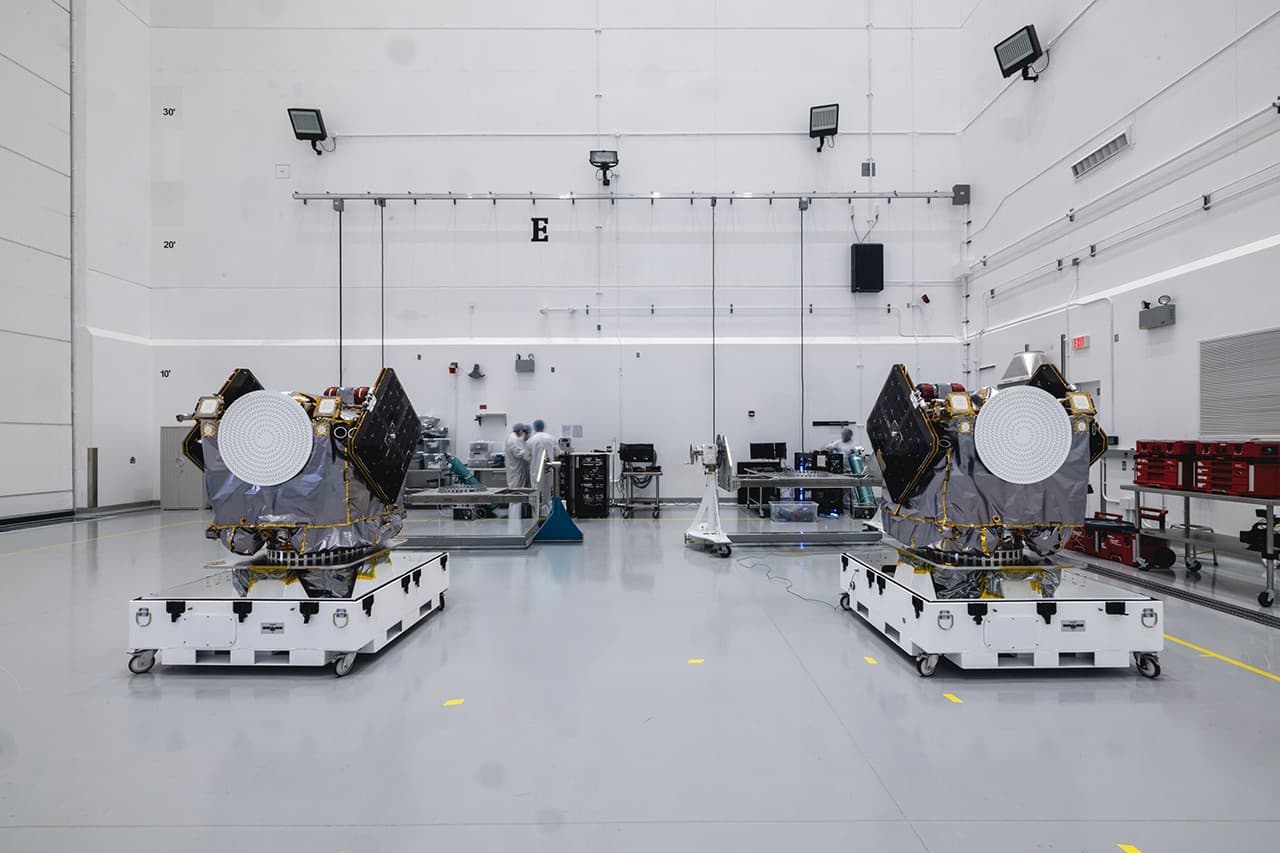
This caution also applies to images. The photograph of the two probes used here shows the equipment before the journey, and the trajectory animation explains a planned geometry. Neither of these is an image taken during the November flybys. If NASA subsequently releases views or measurements of the flybys, they can enrich this dossier with their date and context. The primary purpose of a medium is to make the mechanism understandable; its caption should prevent an illustration from being taken as proof of an event yet to come.