
On 2 November 2026, the European Space Agency announced that ERMIS-3, a Greek CubeSat, had established an optical link between low Earth orbit and a ground station in Greece. The result involved laser transmission, not just radio contact with the satellite. It shows that a very compact device can point a beam accurately enough at a ground installation to communicate. The demonstration does not yet mean that a commercial network is operating continuously; the team plans further tests. For universities considering building small satellites, this step illuminates the work required between a laboratory experiment and a reliable service in orbit.
Why transmit by light?
Most satellites use radio links to send commands and data. Optical systems use highly focused light, often a laser, which can carry a lot of information while using another part of the spectrum. When onboard sensors produce detailed images, the amount of data to be transmitted can become a limiting factor. An optical link promises high throughput and can alleviate some constraints related to the availability of radio frequencies. However, it requires demanding geometry and pointing accuracy.
A laser link is not automatically better in all situations. Clouds, atmospheric turbulence, and visibility from the ground station limit the communication window. The small size of a CubeSat also complicates maintaining orientation. It must know where the ground station is, point its terminal, detect the signal, and track the target as the satellite quickly moves across the sky. Engineers often talk about acquisition, pointing, and tracking. A narrow beam provides potential for higher data rates, but leaves less room for error.
What ERMIS-3 actually demonstrated
According to ESA, ERMIS-3 established an optical link with the Holomondas station in Greece. The agency describes this operation as the first of its kind to be carried out from Greece to a low Earth orbit satellite. The miniature optical terminal was developed as part of the Greek programme, with the participation of universities, companies and ESA. The satellite is an 8U format: its dimensions are constrained by standardized units, making the integration of the optics and control system more challenging than on a large vehicle.
It is important to distinguish between establishing the link and demonstrating all future uses. A successful first acquisition proves that a significant part of the chain is functioning: the terminal, the pointing, the ground station, and the operating procedures. It does not, however, by itself, provide the average throughput over several months, the availability rate under different climates, or the actual cost of a network of stations. These figures will be necessary to judge the place of optics in operational missions.
The role of the laboratory in orbital success
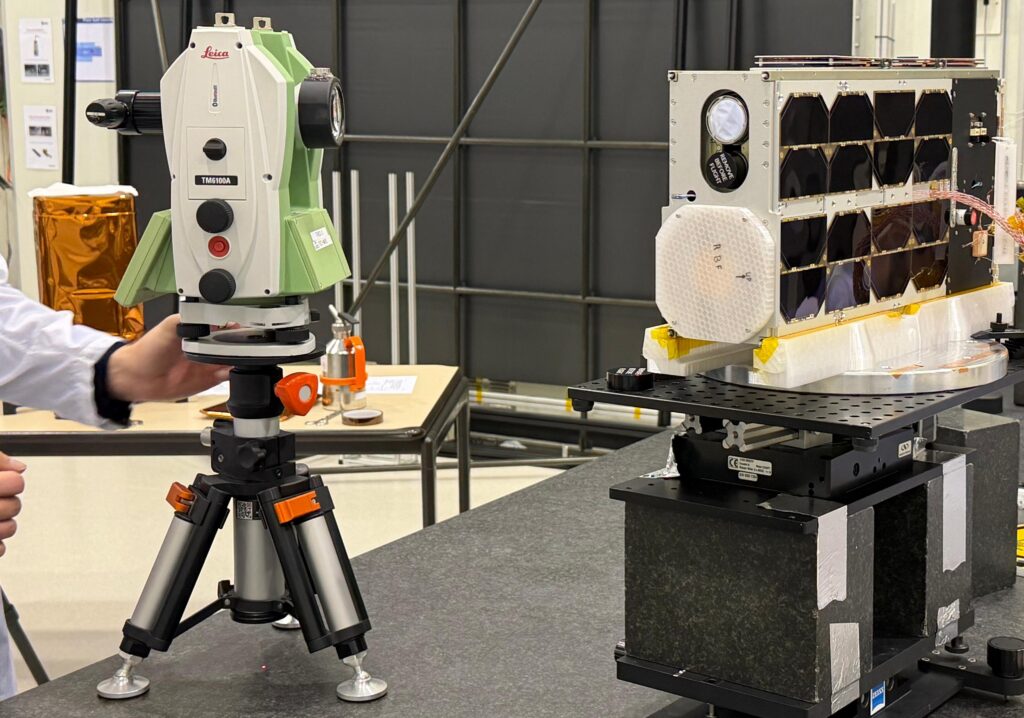
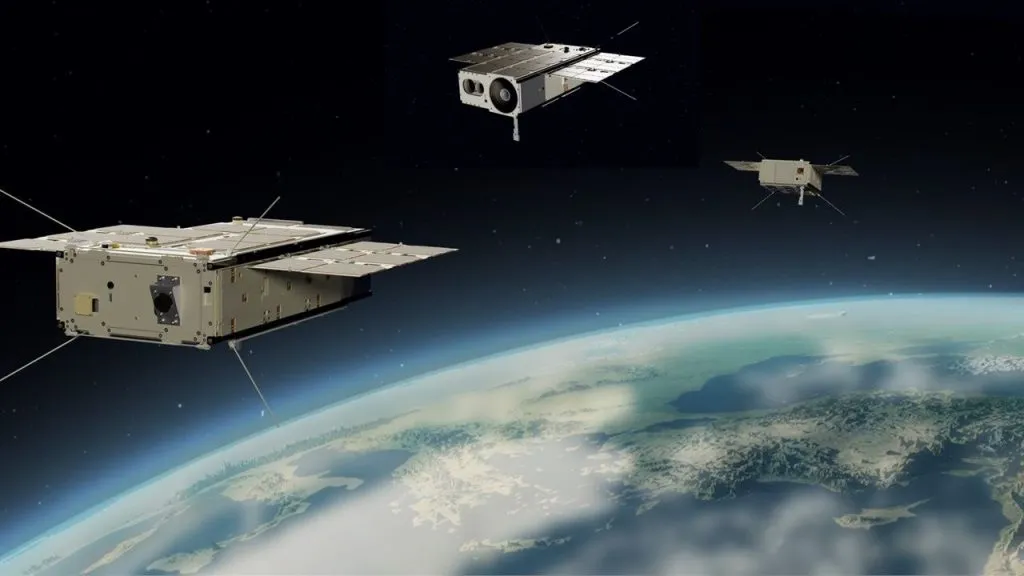
The cover image shows ERMIS-3 during an optical alignment at ESA's ESTEC facility, prior to the announcement. Environmental tests also verify that the spacecraft can withstand the stresses of launch and spaceflight. A space link sometimes fails because of a small assembly error, a thermal problem, or an alignment mismatch that could have been detected on the ground. Documenting these steps is more useful to young engineers than simply showing an artist's view of the satellite above Earth.
The mission brings together ERMIS-1, ERMIS-2 and ERMIS-3, under the leadership of the National and Kapodistrian University of Athens. ESA describes a university space centre comprising assembly, integration and testing facilities. This infrastructure does not automatically guarantee success, but it does enable teams to be trained and procedures to be rehearsed. For a country building its space capability, the challenge is not simply to buy a ready-to-launch object: it is to know how to test it, operate it and explain what its data demonstrate.
A hyperspectral camera in the program suite
ERMIS-3 also carries a hyperspectral camera. This type of sensor measures light in many bands and can produce detailed data on the surfaces being observed. ESA says the mission aims to demonstrate the rapid transmission of these images. Keep in mind the future in that sentence: the existence of the camera and the success of a first link do not prove that regular, high-speed hyperspectral imaging has already been validated. Future tests will need to link acquisition, storage, compression, and transmission.
The satellite also has a data processing load and compression algorithms. The entire system resembles an embedded computing system with tight energy and mass constraints. An image must be captured at the right time, calibrated, sometimes compressed, and then transmitted during a visibility window. If the optical link is interrupted by weather or pointing issues, recovery strategies and storage capabilities are required. The performance of a terminal is therefore not just measured by its peak throughput.
What RECA can retain
ERMIS-3 news relate to three fields: space instrumentation, telecommunications, and the operation of ground stations. A Cameroonian university team can study the problem as an educational project: calculate the duration of an orbital pass, estimate the effect of a pointing error, compare a radio link and an optical link, and then define what should be measured during a test. A ground station is not just a receiver; its location, weather, clocks, and procedures are all part of the experiment.
On November 5, the news was the first demonstration announced by ESA. Detailed measurements of throughput, availability, and repeatability remain to be seen. Clearly presenting this boundary between established evidence and future goals helps to understand the scope of the experiment without reducing it to a marketing promise.
A link must be found on each pass
A CubeSat in low Earth orbit doesn't stay still above a station. It enters the visible zone, quickly crosses the sky, and exits. To communicate, the team must know its trajectory, orient the satellite terminal, and align the ground station during this short window. Weather can also interfere with an optical link: clouds and atmospheric turbulence alter the path of light. Successfully establishing a first connection proves that a complete chain has functioned under given conditions. To build a regular service, we must measure the recurrence of this success over many passes and explain the failures.
The throughput reported during a demonstration is just one indicator among many. An operator must also know how long the link remains available, how much data is actually received, how errors are corrected, and what proportion of the traffic is lost. A solution may achieve high speeds for a few seconds while delivering little data over a week. These future figures will allow for a fair comparison of optical to other transmission methods, not forgetting that the two techniques can be complementary depending on the mission.
An experience tailored for small teams
The Greek project shows the value of collaboration between laboratories, industry and station operators. The alignment bench visible in the photograph is an essential element: pointing errors are first reduced on the ground, with repeatable procedures. An African university program could begin with a ground demonstrator linking two buildings, then document beam stability, throughput and interruptions due to the environment. The space stage would then require qualification, safety and orbital operations. This progression avoids confusing a pedagogical proof with a flight-ready system, while training the skills that make future missions possible.