
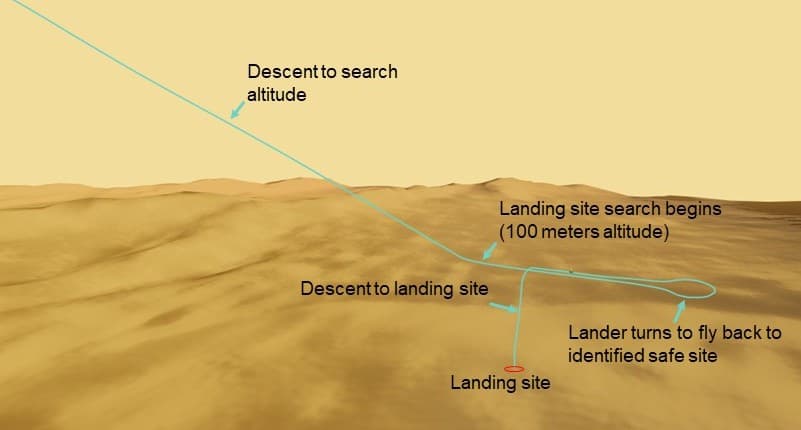
The scene looks like an arrival on Titan: Dragonfly leaves his protection, searches for a safe area, bypasses a landing site and descends. But the terrain is virtual. The test took place on a computer bench at the Johns Hopkins Applied Physics Laboratory (APL) in Maryland, not in the atmosphere of Saturn's moon. This is the essential point oftheannouncement released by NASA on October 23.
What was really tested?
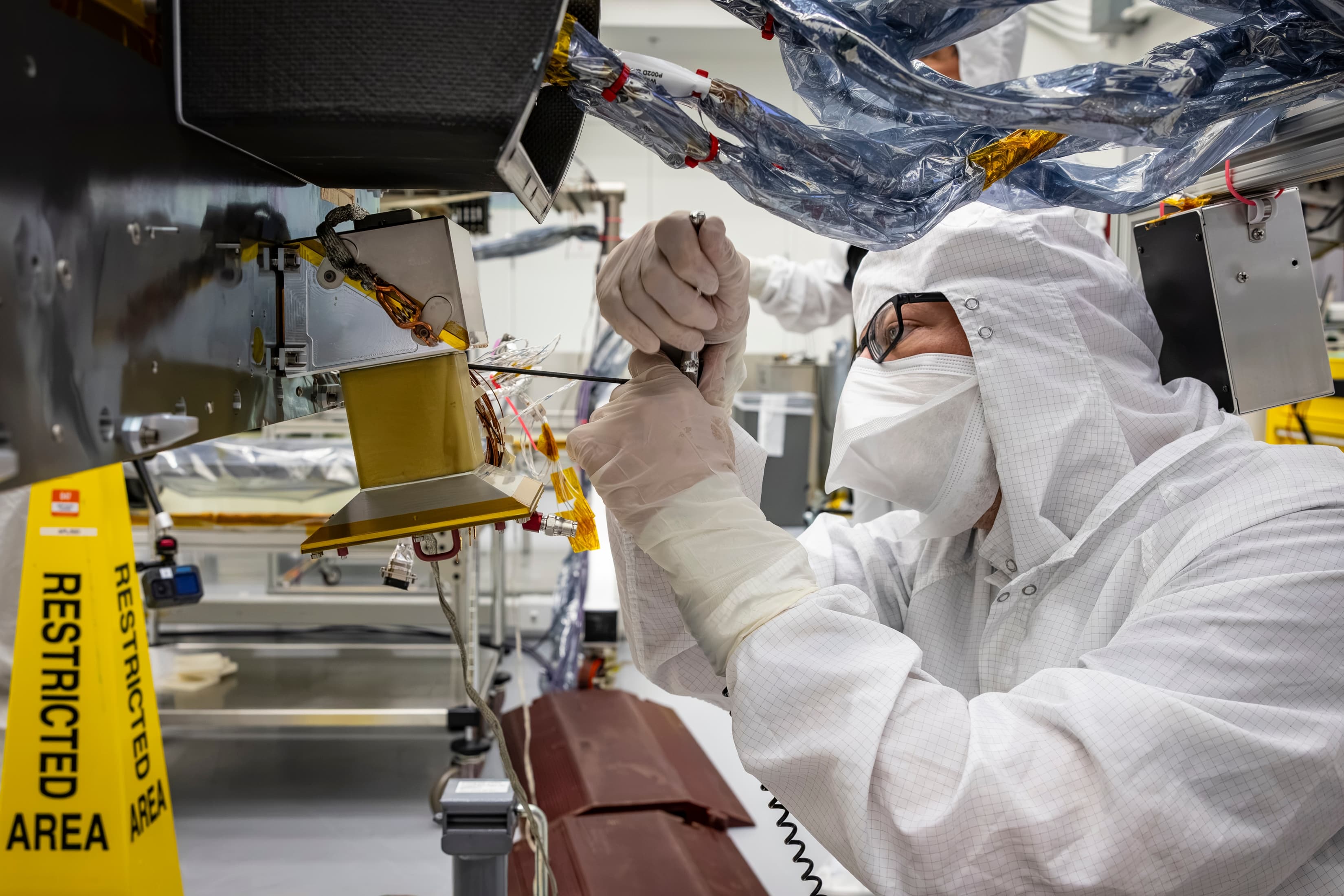
NASA describes its most complete repetition to date of this flight sequence. The onboard software and representative avionics worked with simulated data from the sensors that Dragonfly will have to use on Titan: navigation cameras, inertial measurement units and lidar. The team also generated in real time the images that the cameras would have received in a simulated landscape. The aim was to verify that perception, choice of a landing area, guidance and commands follow each other correctly, including within the processing times of the onboard computer.
The test therefore does not yet prove that the actual rotorcraft can fly on Titan. NASA says the next campaign will replicate this first sequence on Dragonfly's flight system, and then add more profiles and intentionally introduced outages. These steps are separate from the simulation announced this week.
Why this autonomy is decisive
On Titan, Dragonfly will have to decide locally where to land: a ground team cannot fly each correction like a nearby drone. Simulation therefore combines sensors and calculations in a testable decision chain. Lidar is used in particular to estimate height, slope and obstacles; cameras and inertial measurements help to reconstruct movement. It is not a simple animated film: the test makes equipment and software work in representative time conditions, with a digital environment.
Follow-up to the mission
According to the timetable released by NASA, Dragonfly is scheduled to launch at the earliest in 2028 and reach Titan by 2034. The rotorcraft must then explore several sites to study the chemistry, geology and atmosphere of this moon. Before this, the team will still have to check all flight equipment, other trajectories and the response to possible failures.
The lesson of this announcement is methodological: an autonomous mission is built by progressive trials, clearly separating simulation successful, real system validation and flight on site. Confusing these three steps would give a misleading picture of Dragonfly's progress.