
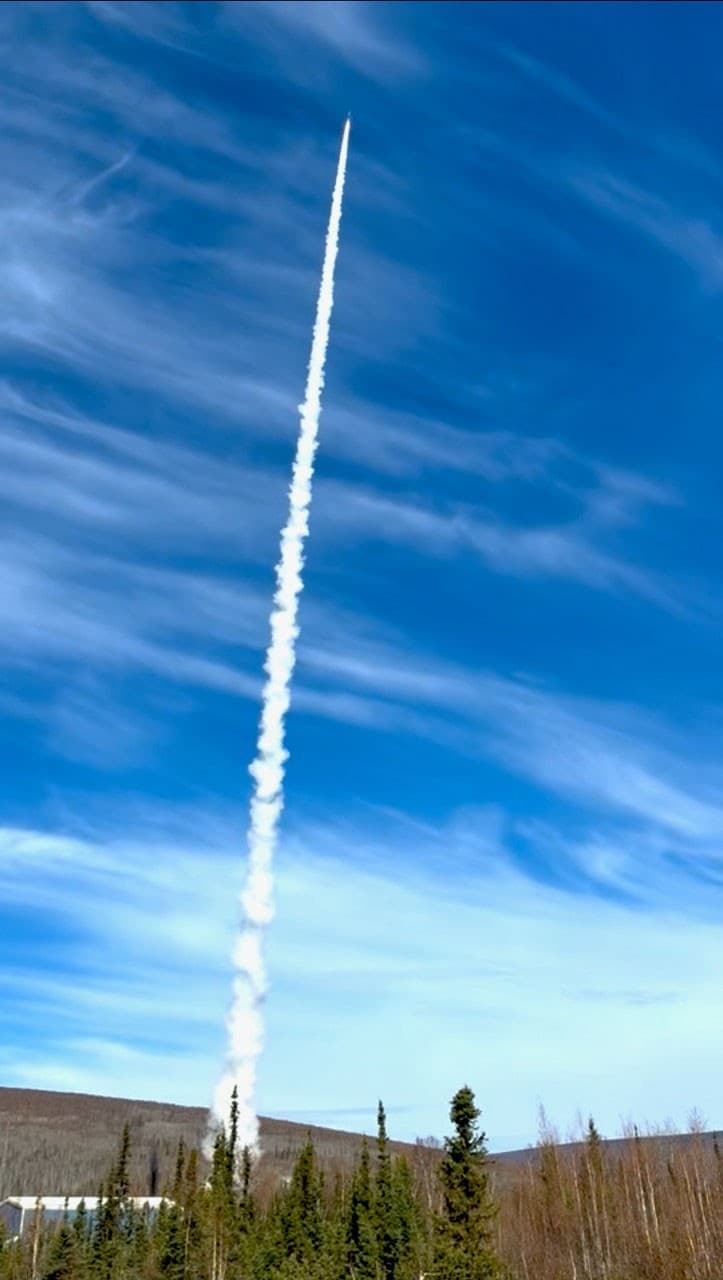
A spacecraft observing the Sun has a working window of only a few minutes. A solar eruption can also develop very quickly. Launching without knowing whether the phenomenon will still be present above the atmosphere is like betting a scientific campaign on a coincidence. In an announcement published on November 4, 2026, NASA explains that a new alert system has made it possible to better choose the time of launch. The FOXSI-5 rocket, launched from Alaska on May 14, was able to observe three small eruptions during its flight. The result links a prediction idea to a verifiable operational decision.
Why use a rocket-probe instead of a satellite?
A sounding rocket temporarily passes through the layers of the atmosphere that block certain wavelengths, then falls back to Earth. It can carry a specialized scientific instrument at a cost and within a timeframe different from those of an orbital mission. FOXSI-5 observes the X-rays emitted by active regions of the Sun. These signals can reveal energetic processes that are difficult to distinguish with other instruments. But the useful flight lasts about five minutes: the team must target an event that occurs precisely within this short period.
A satellite in orbit can look at the Sun for longer, but it is not always designed for the same type of measurement, resolution, or instrument experience. A rocket-sonde also allows an instrument to be tested before a possible future mission. Comparing the two approaches as if one simply replaces the other misses the point: their complementarity. Observatories that continuously monitor the Sun can guide the launch of a highly specialized instrument that has only brief access to space.
From detection to decision
The system described by NASA uses X-ray and ultraviolet observations of active regions. The data come from the Solar Dynamics Observatory, GOES weather satellites, and ground-based observatories. The algorithm looks for the location of an eruption and estimates whether it will remain observable for the time needed to prepare and carry out the launch. The alert must arrive quickly, but it must also be precise enough for the team to know whether the target will be within the field of view of their instrument.
A forecast is not an automatic firing order. Officials also check the launch site's security, local weather, rocket availability, communications, and instrument status. The value of the alert is to turn scientific uncertainty into information that can be used by a launch team. To evaluate the method, one must compare the announcements made before the launch with the actual event recorded after the flight, rather than just showing a picture of the rocket in flight.
What has already been demonstrated
NASA reports that the system helped coordinate two launches from Alaska in April 2024. An improved version was then used in May 2026 for FOXSI-5. The rocket observed three small eruptions, which met the goal of obtaining data on an ongoing phenomenon. The study detailing the alert system was published on November 4 in The Astrophysical Journal. The news therefore concerns the publication of a method and its experience, not a launch that occurred on November 4.
This precision in dates is important. An image of the May launch may illustrate the story, but its caption should state that it documents a previous operation. Data from the instrument still need to be analyzed to answer scientific questions about the physics of eruptions. The success of a launch strategy does not mean that all the mechanisms for heating and accelerating particles in the Sun are understood.
Why do eruptions affect Earth
The Sun releases energy and particles that can interact with the Earth's space environment. Some events disrupt radio communications, satellite navigation, or satellite operations. The effects depend on the nature, intensity, and direction of the event. A small eruption observed by FOXSI-5 is not automatically a threat to African networks. Linking each solar observation to a terrestrial outage would be a shortcut without measuring the space context and without local diagnosis.
Space weather, however, involves very practical skills for satellite operators and telecommunications engineers: monitoring alerts, understanding uncertainties, protecting sensitive systems, and documenting incidents. A laboratory or university can use open solar data to train students to detect an event, verify its time in multiple instruments, and distinguish correlation from causation. The NASA announcement provides a rare example where prediction is not just a graph: it changes the timing of a scientific operation.
What else needs to be measured
Three eruptions observed during a flight are a campaign success, but they alone do not provide a reliable measure of the system's performance. To determine how useful the alert would be under other conditions, more cases will need to be examined: predicted eruptions that end too soon, missed events, delays between detection and decision-making, and performance according to the available instruments. A well-considered forecast publishes its false positives and false negatives as clearly as its successes.
So the contribution of FOXSI-5 is twofold. It provides observations of X-ray eruptions and tests a way to coordinate permanent sensors with a short-lived spacecraft. This logic is relevant beyond the Sun: when an expensive experiment must target a fleeting phenomenon, the quality of the decision depends on the entire chain, from the initial measurement to the post-event validation.
What an X-ray machine sees
A solar flare releases energy in a region of the Sun's atmosphere. X-rays allow us to study a portion of the hot plasma and track the event's evolution. A sounding rocket can carry a specialized instrument and briefly reach an altitude where the Earth's atmosphere no longer blocks these rays. In return, the observation window is short, and the launch must target the right moment. The alert system described by NASA serves to turn continuous observations of the Sun into operational decisions for this limited window. It is not a perfect prediction of all future eruptions.
The May success and the November announcement address different questions. The flight provided scientific data on three small eruptions; the November 4 article explains how the team chose to launch during a promising activity. The launch images show the rocket taking off, but they do not replace the solar measurements collected by the instrument. A good read therefore crosses the timeline of alerts, the launch time, and the observations obtained. It avoids presenting a spectacular photograph as proof of an algorithm's performance.
A method for rare events
The decision can be described as a measurable compromise. Waiting too long may miss the eruption; acting too soon may waste an opportunity for a flight without an interesting event. Teams must define alert thresholds, preparation time, and conditions that prevent a launch, and then compare the decisions to the actual events observed. The method is also of interest to researchers who monitor other short-lived phenomena, such as certain astronomical bursts or atmospheric events. In each case, continuous monitoring can guide an instrument that only operates for a short time, provided that the data and errors are documented.